
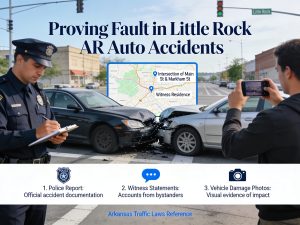
 After a serious car accident, one of the most common — and most stressful — questions injured people ask is “Who was actually at fault?” In Arkansas, the answer to that question can determine whether you recover compensation at all, how much you may receive, and how aggressively an insurance company fights your claim.
If you were injured in a crash in Little Rock, working with an experienced local attorney can make a measurable difference. Below, we break down how a Little Rock car accident lawyer proves fault, what evidence matters most, and why Arkansas law makes proper investigation essential.
Why Proving Fault Matters Under Arkansas Law
Arkansas follows a modified comparative fault system. This means:
- You can recover compensation only if you are less than 50% at fault
- Your recovery is reduced by your percentage of fault
- If you’re found 50% or more responsible, you recover nothing
Insurance companies know this and often try to shift blame early. A skilled car accident lawyer’s job is to lock down the facts before that happens and build a clear liability narrative supported by evidence.
Step 1: Conducting an Immediate Accident Investigation
A strong case starts with early investigation. Evidence can disappear within days — skid marks fade, vehicles are repaired, and witnesses forget details.
A Little Rock car accident lawyer may:
- Visit the crash scene
- Photograph road conditions, signage, and sightlines
- Identify nearby traffic cameras or businesses with surveillance footage
- Preserve vehicle damage evidence
Local familiarity with Little Rock roads, intersections, and traffic patterns often helps attorneys spot contributing factors others might miss.
Step 2: Analyzing the Police Accident Report
Police reports often form the foundation of a fault analysis. While not conclusive on their own, they carry significant weight with insurers.
An attorney will review:
- Officer observations
- Diagrams and measurements
- Any citations issued
- Statements from drivers and witnesses
If errors or omissions appear, your lawyer can supplement the record with additional evidence or clarifying statements.
Step 3: Using Witness Statements to Clarify What Happened
Neutral third-party witnesses can be powerful. They often confirm:
- Who had the right of way
- Whether speeding or reckless driving occurred
- Traffic signal status at the time of the crash
A lawyer ensures witness statements are formally documented, consistent, and preserved for negotiation or trial if necessary.
Step 4: Leveraging Physical and Digital Evidence
Modern accident cases rely heavily on objective data. Your attorney may collect and analyze:
- Vehicle damage patterns to show angle and force of impact
- Event data recorders (black boxes) from newer vehicles
- Dashcam or traffic camera footage
- Cell phone records in distracted driving cases
This type of evidence is especially persuasive when liability is disputed.
Step 5: Accident Reconstruction When Fault Is Contested
In more complex cases, lawyers may work with accident reconstruction experts. These professionals use physics, engineering, and data analysis to recreate the collision.
Reconstruction may demonstrate:
- Speed at impact
- Brake application timing
- Driver reaction times
- Whether the crash was avoidable
Expert analysis can be decisive when insurance companies refuse to accept responsibility.
Step 6: Proving Negligence Under Arkansas Law
To establish fault, a lawyer must prove negligence, which includes four elements:
- Duty of care – Drivers must operate vehicles safely
- Breach of duty – Speeding, distraction, intoxication, or violations
- Causation – The breach caused the crash
- Damages – Injuries, medical bills, lost income, and pain
Evidence is organized to clearly connect these elements — not just suggest them.
Step 7: Addressing Shared Fault Claims
Insurance companies frequently argue that the injured driver:
- Was speeding
- Failed to brake in time
- Was distracted
- Could have avoided the crash
A Little Rock car accident lawyer anticipates these arguments and uses evidence to minimize or eliminate comparative fault, protecting your ability to recover compensation.
Step 8: Presenting a Persuasive Claim to Insurers or a Jury
Proving fault isn’t just about collecting evidence — it’s about telling a clear, credible story.
Your attorney organizes evidence into a compelling narrative that:
- Demonstrates why the other driver’s actions caused the crash
- Anticipates defense arguments
- Shows the real-world impact of your injuries
This preparation strengthens settlement negotiations and ensures trial readiness if needed.
Why Local Experience Makes a Difference
Working with a firm like Pfeifer Law Firm means your case is handled by attorneys who understand:
- Arkansas traffic and liability laws
- Local courts and procedures
- How insurers handle claims in the Little Rock area
If you want to learn more about personal injury representation in the area, you can explore their Little Rock personal injury practice or review the background of Paul Pfeifer to understand the experience behind the advocacy.
Frequently Asked Follow-Up Questions
What if there were no witnesses?
Fault can still be proven using physical evidence, vehicle data, police reports, and expert analysis.
Can fault be proven if I was partially responsible?
Yes. As long as you are less than 50% at fault, Arkansas law allows recovery.
How long does it take to prove fault?
Straightforward cases may resolve in weeks. Complex or disputed cases can take months, especially if litigation is required.
Final Thoughts
Proving fault after a car accident is not about guesswork — it’s about methodical investigation, strategic evidence gathering, and a deep understanding of Arkansas law. A skilled Little Rock car accident lawyer builds your case from the ground up, protecting your rights and positioning you for the best possible outcome.
If you’ve been injured in a crash and are unsure how fault will be determined, speaking with a qualified attorney early can make all the difference.